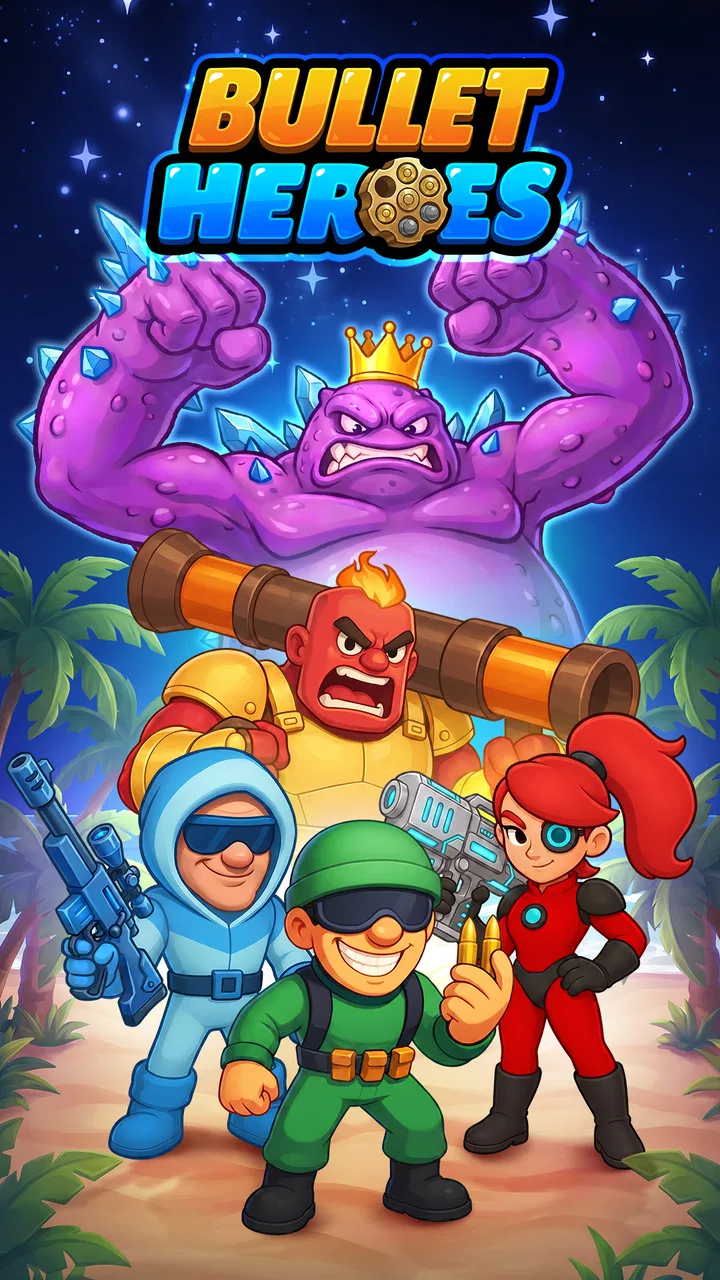
Bullet Heroes: TD RPG Shooter
- 4.3
- Rating
- 1.00M
- Installs
- Free
- Price

 Analysis by App-foxy
Bullet Heroes: TD RPG Shooter is the kind of action game I can imagine opening for a quick burst between errands, then staying longer than planned because one more upgrade feels within reach. It combines tower-defense positioning with direct, ammo-focused survival, so I am not simply watching defenses work on their own. I have to manage the pressure of incoming enemies while also thinking about how my shooting and improvements will carry the next encounter. That combination gives it a more active feel than a conventional tower-defense title.
Created by Homa, this free game sits in the action category and is aimed at players aged Everyone 10+. It has attracted over 500 thousand installs and holds a 4.0 average from around 4.7 thousand ratings, which suggests a reasonably broad audience without making it look like an automatic recommendation for everybody. My overall impression is positive, but with an important qualification: the game is most appealing if you enjoy short, upgrade-driven action sessions and can accept the possibility that spending may become part of the long-term experience.
How the shooting and defense loop feels in practice
The central appeal is the overlap between two jobs. Tower defense normally asks me to prepare a layout, choose priorities, and let the defensive setup handle much of the action. A shooter usually puts the emphasis on aiming, movement, timing, and immediate reactions. Bullet Heroes: TD RPG Shooter places those expectations close together. I need to think about the defensive side while staying engaged with the flow of ammunition and enemies.
You May Also Like

 Blood Strike: 2.5 Anniversary
Blood Strike’s Loadouts Turn Every Drop Into a Tactical Gamble
A close look at Blood Strike’s custom loadouts: how fast access to signature weapons reshapes its battle royale rhythm, rewards preparation, and narrows the gap between fights.

 Pandora - Music & Podcasts
Pandora’s Music Is Easy to Start, but Harder to Recover
Pandora’s strength is its low-effort path from a seed to a station. Its weak spot is how much confidence it asks you to place in connection, setup, and quiet recovery.

 8 Ball Pool
 Is Built on Rivalries, Rematches, and Routine
A close look at the rivalries, rematches, shared routines, and unanswered safety questions that turn a quick pool match into a persistent mobile community.

 Samsung Music
’s Quiet Strength Is Playing What You Already Own
Its reach comes less from spectacle than from dependable access to a personal library. That simplicity is both the app’s strongest retention engine and its ceiling.

 AccuWeather: Weather Radar
AccuWeather Review: A Quick, Clear Forecast for Everyday Decisions
For everyday plans, the best forecast is the one you can understand quickly. AccuWeather makes rain timing, radar, and local conditions easy to act on, with a few trade-offs.

 Hill Climb Racing
Why Hill Climb Racing Still Turns Crashes Into One More Run
A tiny car, a bumpy hill and one more upgrade: Hill Climb Racing keeps resurfacing because its simple chaos makes every near-miss feel personal.
More From Our News Desk
View All News


That makes the game easier to pick up than a deep strategy title, but more demanding than a passive idle game. I can play it when I want action without committing to a long role-playing session, yet I still have decisions to make rather than merely tapping through rewards. The store’s “Bullet Heroes” label is brief, but the actual identity is clearer once I consider the mix: this is a compact action-defense experience built around surviving pressure and improving the tools that help me do it.
The strongest part of the design, in my view, is the way upgrades give ordinary encounters a sense of direction. A successful run is not just a win; it is evidence that a particular improvement, weapon choice, or defensive decision is beginning to work. That creates a useful rhythm. I enter a stage, react to what is happening, finish with a better understanding of my weaknesses, and return with a stronger setup.
There is also a practical advantage to this format. I do not need the concentration required by a long strategy campaign every time I play. If I have a few minutes while waiting for transport, I can use the game as a focused action break. On the other hand, players who want a relaxed experience may find the constant need to respond to enemies tiring, especially when a run begins to feel like a test of resource management rather than a simple power fantasy.
Why ammunition changes the way I approach a stage
The ammunition emphasis matters because it gives the shooting side a different kind of tension. I cannot treat every target as an excuse to fire without thought. Even when the game feels fast, I am encouraged to notice when I am wasting shots, when a threat deserves immediate attention, and when defensive preparation can buy me time. That is a more interesting decision than simply holding down an attack button until the screen clears.
One useful habit is to avoid spending every available resource as soon as a wave becomes uncomfortable. I prefer to keep a reserve for the moment when several threats overlap. This is not a promise that every stage can be solved by careful conservation, but it is a sensible way to reduce panic during difficult sections. The game feels better when I treat ammunition as part of the plan rather than as a background detail.
Another practical tip is to judge an upgrade by the problem it solves, not only by its immediate strength. If I am losing because enemies reach the defensive line too quickly, a purely offensive improvement may not fix the real issue. If I am surviving but taking too long to clear threats, then a defensive choice may simply stretch the same problem. This way of thinking makes the progression more satisfying and helps prevent random spending of earned resources.
A realistic everyday session
Imagine opening the game during a ten-minute break. I would not begin by trying to master every system. I would play one stage with attention to where the pressure starts, notice whether ammunition or enemy numbers cause the failure, and then make one deliberate improvement before trying again. That approach keeps the session useful even if I do not win immediately.
For a longer evening session, I would use the same loop more carefully: play until I identify a consistent obstacle, stop upgrading blindly, and decide whether the problem is timing, target priority, or insufficient progression. This is where the game can feel more strategic than its quick-action presentation initially suggests. It rewards observation, although players who want a completely transparent tactical puzzle may still find the action layer a little hectic.
Progression, pressure, and the cost of chasing improvement
Progression is the reason I would keep returning after the novelty of the shooting wears off. Each attempt has the potential to make the next one feel more manageable, and that creates a familiar but effective motivation loop. The danger is that this same structure can turn difficulty into pressure. When a game repeatedly places a new improvement just beyond reach, I start asking whether I am learning a better approach or simply being encouraged to grind.
That distinction matters for a free-to-play action game. Bullet Heroes: TD RPG Shooter costs nothing to download, but it includes in-app purchases ranging from $0.99 to $99.99 per item. Those prices make spending a meaningful part of the decision for some players, even if they never buy anything. I would approach the game as free first, set a personal spending limit before playing seriously, and avoid treating a difficult stage as a reason to purchase immediately.
The broad price range also means the game may serve different kinds of players unevenly. Someone who only wants occasional action can simply enjoy the free entry point and stop when progression becomes demanding. A more committed player may be tempted by purchases that promise a smoother route forward. Since the available purchase facts do not establish exactly what each item provides, I would not assume that paying is necessary, nor would I assume that it has no effect on the pace of progress. That is a reason to stay cautious rather than a reason to accuse the game of unfairness.
My preferred approach is to use a waiting period before buying anything. If I hit a wall, I replay earlier content, test a different upgrade priority, and see whether the problem is genuinely mechanical. If the game remains enjoyable without payment, that tells me I am playing for the action itself. If the experience only feels satisfying once spending enters the picture, I would consider that a sign to move on rather than continue escalating the cost.
What makes the pressure manageable
The game is easier to enjoy when I give each run a specific purpose. One attempt can be about learning enemy timing, another about testing ammunition discipline, and another about seeing whether a defensive improvement changes the outcome. This stops failed runs from feeling completely wasted. It also gives me a way to separate genuine skill development from simple numerical progression.
I would not recommend rushing through every available improvement. A scattered setup can leave me with several partially useful advantages and no clear answer to the stage’s main threat. Focusing on the weakness that causes most failures is more efficient and makes the progression feel less arbitrary. This is one of the less obvious strengths of the format: even with a simple action premise, the player can impose a useful decision-making structure on the upgrade loop.
There is a trade-off, though. Players who prefer a clear campaign with predictable milestones may find the pressure of repeated improvement less appealing. The game is better suited to someone who enjoys experimenting and retrying than to someone who wants to complete a fixed story at a steady, guaranteed pace. If I know I dislike repeating stages or adjusting builds, I would probably choose a more traditional action game instead.
Who should skip it
I would skip Bullet Heroes: TD RPG Shooter if I wanted a purely competitive experience where every player’s power comes from the same fixed conditions. I would also skip it if I found ammunition management irritating, because that element is central to the game’s identity rather than a minor decoration. The same applies to players who dislike free games with optional purchases visible in the wider experience.
It is also not my first choice for someone seeking a deep, slow tower-defense simulator. The active shooting component changes the tempo and asks me to participate directly. Conversely, a player looking for a fully open-ended shooter may find the defensive and upgrade structure too restrictive. The best audience is in the middle: people who want action, but also enjoy making small strategic choices about survival and progression.
Fairness, competition, and what I would watch closely
Fairness is difficult to judge from the purchase range alone. The game is free to play, and the known purchase options extend from a small amount to a much larger one, but that does not reveal whether purchases affect competitive outcomes, speed up progression, provide convenience, or simply offer optional content. I would therefore avoid calling it pay-to-win without direct evidence. At the same time, I would not dismiss the concern, because a broad purchase range deserves careful attention from anyone who values equal progression.
For my own use, the key test is whether I can make meaningful progress through play and whether difficulty encourages better decisions rather than immediate spending. I would compare my experience over several sessions, not judge it from one frustrating stage. If careful ammunition use and targeted upgrades continue to matter, the game can feel fair even when it is challenging. If improvement seems to depend mainly on purchases, the balance would feel less comfortable.
There is another fairness question for competitive-minded players: whether the game actually offers a meaningful player-versus-player environment. The confirmed details establish an action game with tower-defense and survival elements, but they do not establish a competitive mode or explain how rankings might work. I would not buy into it expecting esports-style competition. I would treat it primarily as a personal progression game unless the in-game experience clearly demonstrates otherwise.
That expectation protects the experience from a common mistake. A player can enjoy building a stronger run and still decide that the game is not suitable for serious competition. Those are different standards. For casual play, a little unevenness in progression may be tolerable. For a competitive environment, even small advantages tied to purchases would matter much more. I would keep those expectations separate.
Spending without losing control of the experience
Because the game is free to start, I would recommend beginning with a no-purchase trial period. The goal is not to prove that free play is always sufficient; it is to learn whether the shooting loop, defense decisions, and retry cycle are enjoyable before money becomes part of the relationship. If I am already bored without paying, a purchase will not solve the underlying problem.
If I did decide to spend, I would make one small, deliberate purchase rather than moving straight toward the most expensive option. The listed range reaches $99.99 per item, so impulse buying could become disproportionate to the short-session nature of the game. I would also avoid buying during a frustrating loss. A purchase made immediately after failure is more likely to be a reaction to pressure than a considered choice.
This is not a criticism of every optional purchase. Some players are happy to pay for convenience or to support a game they use often. My concern is control. The game works best for me when spending remains a choice that follows enjoyment, not a condition for recovering enjoyment after progression slows down.
What I still treat as an open question
The current version is 118, and the game was released on April 4, 2025. Those details tell me that I am looking at a relatively recent title with active versioning, but they do not by themselves explain how its systems have changed over time or how future updates may affect progression. I would keep that in mind before investing heavily in a long-term routine.
I also would not infer a complete purchase philosophy from the price range. Knowing that individual items run from $0.99 to $99.99 does not tell me whether the game presents frequent purchase prompts, whether progression can be completed comfortably without paying, or whether the most expensive options are relevant to ordinary play. Those are practical questions I would answer through actual use, not assumptions.
Similarly, the 4.0 average from around 4.7 thousand ratings gives me a useful general signal, but it is not a substitute for reading recent player experiences or trying the game personally. A rating at that level suggests a mixed but broadly acceptable reception. It does not guarantee that the balance, advertising experience, or progression pace will suit my preferences.
The same caution applies to device expectations. The game supports Android devices from version 7.1 onward, which makes its stated compatibility fairly accessible for many users. Compatibility alone does not tell me how comfortable the controls will feel on every screen size or how demanding longer sessions may be. I would still test the game briefly on my own phone before deciding whether it deserves regular play.
How it compares with the usual alternatives
Compared with a standard tower-defense game, Bullet Heroes: TD RPG Shooter gives me more direct responsibility. I am not only arranging defenses and waiting for the result; I am involved in the action and the ammunition decisions. That makes it more exciting for players who find traditional tower defense too passive, but less relaxing for people who enjoy watching a carefully prepared layout unfold.
Compared with a conventional mobile shooter, it offers more reasons to think beyond the current target. My choices about improvement and defense influence how I approach later pressure, so the game is not just about reflexes. The trade-off is that it may feel less pure than a shooter built around movement and aiming alone. Players who want immediate gunplay without progression management may prefer a simpler action alternative.
It also differs from a typical role-playing game. The upgrade loop provides a sense of growth, but I would not approach it expecting the character depth, narrative structure, or expansive exploration associated with a full RPG. The “RPG” part of the identity is most useful as a description of progression and improvement, not as a promise of a large role-playing world.
My trust verdict after weighing the trade-offs
I recommend Bullet Heroes: TD RPG Shooter to players who enjoy active tower defense, short survival challenges, and the satisfaction of solving a stage by improving one weakness at a time. Homa has built a concept that is easy to understand but has enough tension to make ammunition choices and defensive thinking matter. I especially like it for brief sessions where I want something more involved than an idle game but less demanding than a long campaign.
My recommendation is conditional because the free-to-play structure deserves discipline. The game is free, yet its in-app purchases range from $0.99 to $99.99 per item. I would begin without spending, decide whether the core loop remains enjoyable when progression slows, and only then consider a small purchase. I would not treat the highest-priced option as a natural part of playing, and I would not assume that payment is required or irrelevant without examining the experience directly.
The game’s age rating of Everyone 10+ makes it a reasonable option for that broad audience, but parents should still explain that free access can coexist with optional purchases. For adults, the more important question is whether the action-defense blend matches their habits. If I want quick attempts, visible growth, and enough decision-making to keep a retry interesting, it earns a place on my phone. If I want transparent competitive fairness, a deep traditional tower-defense sandbox, or a shooter without progression pressure, I would choose something else.
In the end, I see Bullet Heroes: TD RPG Shooter as a promising casual action game rather than a title I would recommend blindly. Its strongest quality is the way shooting and defensive planning support each other. Its main caution is the uncertainty around how spending interacts with the long-term progression experience. I would try it, keep my purchases controlled, and judge its fairness by what careful play can accomplish before opening my wallet.
FAQs for Bullet Heroes: TD RPG Shooter
01What is Bullet Heroes: TD RPG Shooter all about?
Bullet Heroes: TD RPG Shooter is a dynamic blend of tower defense and role-playing game mechanics. Players can strategically place heroes and use their unique abilities to fend off waves of enemies. The game offers a variety of characters, each with distinct skills, and allows for strategic upgrades and customizations to optimize your defense strategy.
02Is Bullet Heroes: TD RPG Shooter free to play?
Yes, Bullet Heroes: TD RPG Shooter is free to download and play. However, it includes in-app purchases that allow players to buy in-game currency, special items, or character upgrades. These purchases can enhance gameplay but are not necessary to enjoy the full experience of the game.
03What platforms is Bullet Heroes: TD RPG Shooter available on?
Bullet Heroes: TD RPG Shooter is available for both Android and iOS devices. You can download it from the Google Play Store or the Apple App Store. Ensure your device meets the minimum operating system requirements to enjoy seamless gameplay.
04Do I need an internet connection to play Bullet Heroes: TD RPG Shooter?
Bullet Heroes: TD RPG Shooter primarily functions offline, allowing you to enjoy the game without an internet connection. However, certain features like updates, in-game purchases, or multiplayer modes may require a stable connection to function properly.
05How can I improve my gameplay in Bullet Heroes: TD RPG Shooter?
To excel in Bullet Heroes: TD RPG Shooter, focus on upgrading your heroes and strategically placing them on the battlefield. Experiment with different hero combinations and utilize their unique abilities effectively. Additionally, keep an eye on enemy patterns and continuously adapt your strategy to counter new threats.
Pros
- Engaging tactical gameplay with RPG elements.
- Variety of heroes with unique abilities.
- Stunning graphics and immersive sound effects.
- Frequent updates with new content and challenges.
- Offline mode available for on-the-go play.
Cons
- In-app purchases can be quite expensive.
- Some levels can be overly difficult.
- Requires a stable internet for online features.
- Advertisements can be intrusive at times.
- Limited customization options for characters.

Bullet Heroes: TD RPG Shooter
Gallery